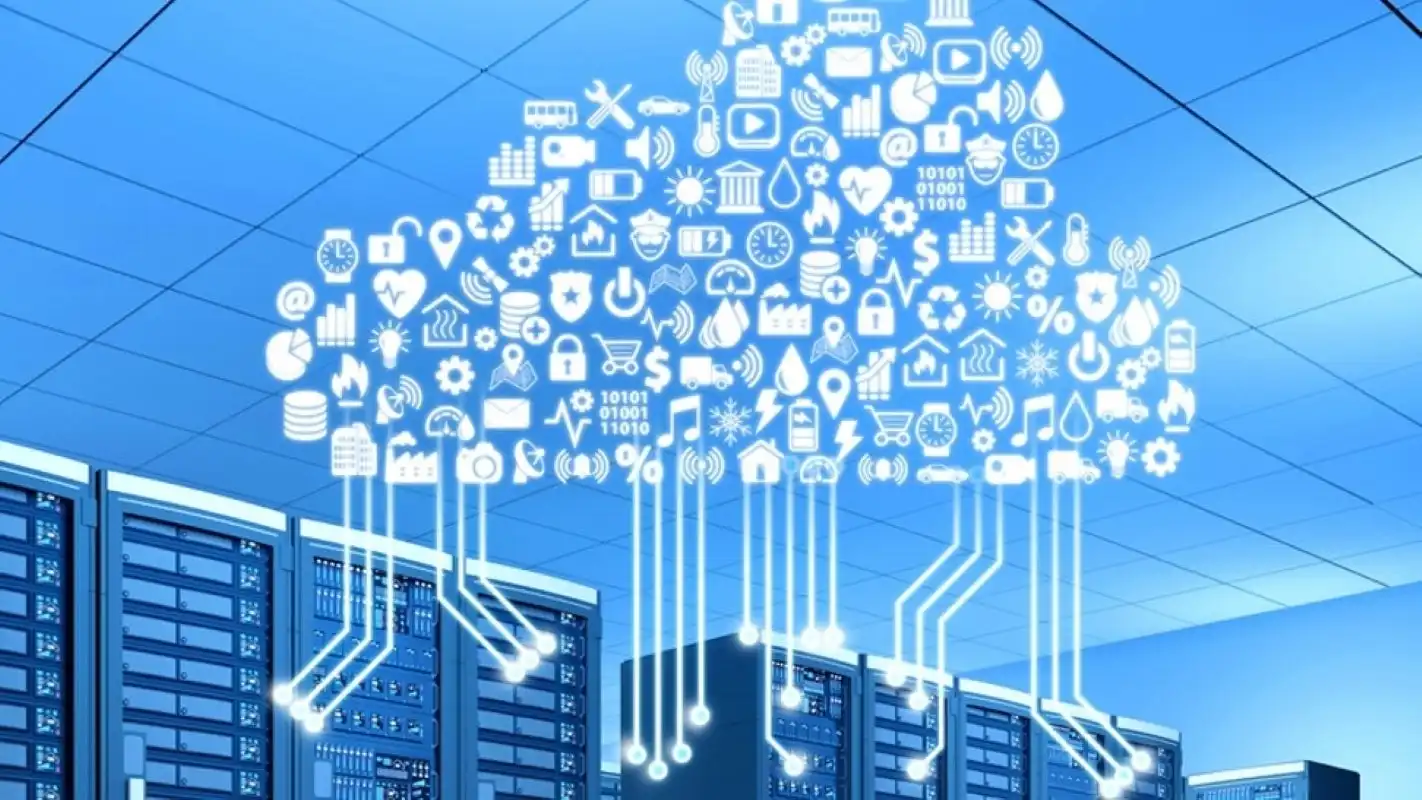
Moving critical workloads from legacy mainframe systems to the cloud carries real risk. A poorly planned migration can cause costly downtime, data loss, or disruptions that ripple across the entire business. Understanding what the process actually involves and where teams most often go wrong is the first step toward a transition that holds up under pressure. The right application modernization tools can mean the difference between a smooth cutover and a recovery effort no one planned for.
Manually rewriting decades of COBOL code or reverse engineering embedded business logic is slow, expensive, and error-prone. Automating that work reduces risk significantly while accelerating the timeline to a modern cloud environment. Teams that want to retire aging infrastructure, cut operational costs, and keep services running without interruption during migration need a practical path forward, and that is exactly what CodeGiant offers as an enterprise AI platform.
Table of Contents
-
Why Are Organizations Moving Mainframe Workloads to the Cloud?
-
What Challenges Can Slow Down Mainframe-to-Cloud Migration?
-
How Can AI Accelerate Mainframe To Cloud Migration?
-
9 Mainframe To Cloud Migration Strategies for Success
-
How to Measure the Success of a Mainframe-to-Cloud Migration
-
How CodeGiant Simplifies Mainframe-to-Cloud Migration
-
Try CodeGiant's Enterprise AI Platform Today
Summary
-
Mainframe-to-cloud migration has a higher failure rate than most project sponsors anticipate. Research cited in the article puts the failure rate at 67%, with the most common causes being undocumented business logic, data conversion errors, and integration dependencies that teams underestimate before the work begins. These are structural blind spots, not random failures, and they repeat across industries from banking to government to healthcare.
-
The financial case for migration is real but not automatic. Organizations that plan carefully and treat migration as a transformation rather than a relocation consistently achieve 60-90% cost reductions post-migration. However, 72% of organizations also report higher-than-expected cloud production costs, which signals that architecture decisions made early in the program have an outsized effect on the final outcome.
-
Talent scarcity is accelerating the urgency in ways that do not always appear in project risk registers. The COBOL and assembler skill pool is shrinking faster than organizations can train replacements, and when senior mainframe developers retire, they often take 30 or more years of undocumented business logic with them. That knowledge loss is a continuity risk that compounds each quarter, not a hiring gap that can be filled with standard recruiting.
-
AI tools are compressing what used to be multi-year modernization programs into shorter, more measurable cycles. AI-assisted code analysis can reduce migration assessment time by up to 70%, and organizations using AI tools for mainframe migration report up to a 40% reduction in overall migration costs, driven by lower labor demand, shorter project durations, and fewer post-migration defects. Toyota Motor North America used AI assistance to modernize over 40 million lines of COBOL to Java in roughly half the projected timeline.
-
Data integrity failures are the most quietly destructive risk in any large-scale migration. Mainframe-specific formats like EBCDIC encoding and COMP-3 packed decimals do not map cleanly to cloud-native databases, and the errors they introduce are subtle enough to pass basic validation before accumulating across millions of records. Analysis of 29 migrations between 2020 and 2025 found that 31% were abandoned mid-project due to data issues alone, with one banking initiative spending $41 million over 52 months before terminating at 40% completion.
-
Hybrid modernization strategies consistently outperform all-or-nothing approaches. A Kyndryl survey of 500 leaders found ROI ranging from 288% for on-mainframe modernization to 362% for workloads moved to other platforms, with average project costs dropping to $7.2 million. Keeping high-performing workloads in place while migrating those that benefit most from cloud elasticity produces better financial outcomes than treating the decision as binary.
-
CodeGiant's enterprise AI platform addresses the undocumented logic problem directly by automating dependency resolution, COBOL-to-modern-language conversion, and traceability mapping across legacy codebases so teams can govern the transformation incrementally rather than betting the program on a single cutover event.
Why Are Organizations Moving Mainframe Workloads to the Cloud?
Businesses move mainframe workloads to the cloud because the economics, agility, and talent dynamics of legacy infrastructure have fundamentally shifted against them. Keeping a mainframe running has become a strategic liability—the cost of staying still now exceeds the cost of moving.
"The cost of staying still now exceeds the cost of moving—making mainframe modernization not just a technical decision, but a critical business imperative."
|
Factor |
Mainframe (Legacy) |
Cloud (Modern) |
|---|---|---|
|
Cost Structure |
High fixed infrastructure costs |
Flexible, pay-as-you-go pricing |
|
Agility |
Slow to scale and adapt |
Rapid deployment and scaling |
|
Talent Availability |
Shrinking specialist pool |
Large, growing developer ecosystem |
💡 Tip: Organizations that delay mainframe migration risk compounding costs — both in infrastructure spend and talent acquisition as legacy expertise becomes increasingly scarce.
⚠️ Warning: Treating mainframe modernization as purely a cost-cutting exercise misses the bigger picture — strategic agility and future scalability are equally critical drivers of the move to cloud.
The financial pressure is real and growing
Old mainframe systems require substantial upfront investment in specialized hardware, power, cooling, and maintenance costs that escalate over time. Organizations must manage unexpected cost increases while handling every update, improvement, and problem independently. According to the IBM Institute for Business Value's Mainframe Advantage report, 72% of organizations paid more than expected for cloud services. Organizations that plan strategically can reduce costs by 60 to 90% after moving to the cloud, but only if they treat the transition as a fundamental transformation rather than a simple migration.
Talent scarcity is the quiet accelerant
The IBM Institute for Business Value report shows that the COBOL and assembler skill pool is shrinking faster than organizations can train replacements for it. When a senior mainframe developer retires, they often take 30 years of undocumented business logic with them—a knowledge continuity risk that compounds quarterly. Incremental cloud migration lets teams extract and preserve that embedded logic before it disappears.
As retirements accelerate and recruitment pipelines shrink, relying on documentation and institutional memory weakens production systems. Our enterprise AI platform at CodeGiant addresses this by automating the analysis and transformation of legacy codebases, surfacing business rules that would otherwise require months of manual reverse engineering.
Innovation velocity is the real competitive argument
Mainframe architecture wasn't designed for modern digital speed. Large, single-piece codebases make even small updates slow and risky, while competitors running cloud-native microservices ship features, respond to customer behavior, and integrate AI capabilities faster. Cloud platforms enable real-time processing, API connectivity, and modern DevOps practices that compress release cycles from months to days. This delivery speed gap compounds over time: businesses that close it earliest define the category standards everyone else chases.
Hybrid paths outperform all-or-nothing thinking
Not every workload belongs in the cloud. Kyndryl's 2025 State of Mainframe Modernization Survey of 500 leaders found return on investment ranging from 288% for on-mainframe modernization to 362% for workloads moved to other platforms, with average project costs at $7.2 million. This confirms a hybrid approach: keep what works best where it is, move what benefits from cloud flexibility, and manage the entire portfolio with visibility and control. The migration decision hinges on continuous optimization across cost, performance, compliance, and capability. That clarity about the destination is reassuring until you discover what stops organizations from getting there.
What Challenges Can Slow Down Mainframe-to-Cloud Migration?
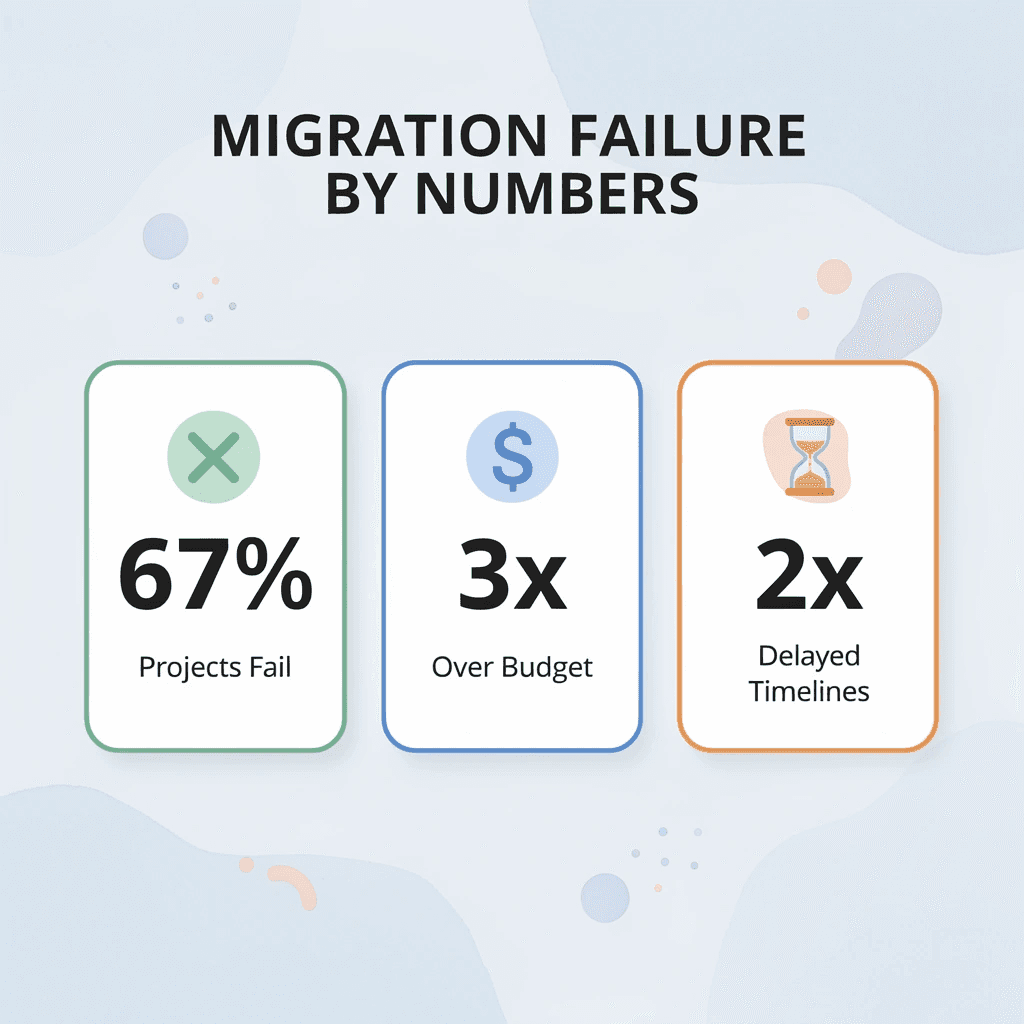
Mainframe-to-cloud migration fails far more often than expected. According to Modernization Intel, 67% of mainframe-to-cloud migration projects fail. These failures follow predictable patterns that come from structural blind spots that show up across industries — from banking to government to healthcare.
"67% of mainframe to cloud migration projects fail — driven by predictable patterns and structural blind spots across industries." — Modernization Intel
🚨 Warning: Most organizations underestimate how deeply these structural blind spots are embedded in their legacy systems — making early risk assessment critical before any migration begins.
|
Industry |
Migration Risk Level |
Common Blind Spot |
|---|---|---|
|
Banking |
Very High |
Legacy dependency mapping |
|
Government |
High |
Compliance & regulatory gaps |
|
Healthcare |
High |
Data sensitivity & integration complexity |
🔑 Takeaway: With 2 out of 3 migration projects ending in failure, the real challenge isn't just technical — it's recognizing and addressing the hidden structural patterns that derail even well-funded initiatives.
The hidden logic nobody documented
The failure point is usually not the code itself, but the business logic buried inside it: logic written by developers who retired years ago and never documented it. Decades of COBOL programs, JCL job streams, and batch processing routines contain conditional rules, exception handling, and calculation sequences that exist nowhere except in the system itself. When migration teams attempt to rehost or refactor these workloads without first fully mapping the logic, they perform surgery without an X-ray. The TSB Bank case, where 1.9 million customers were locked out and remediation costs reached £330 million, exemplifies what happens when undocumented dependency mapping is treated as secondary rather than primary.
When data conversion becomes a silent crisis
Complex data conversion is where migrations often fail quietly. Mainframe data structures like EBCDIC encoding, COMP-3 packed decimals, and VSAM file formats do not map cleanly to cloud-native databases, and the errors they introduce are subtle enough to pass basic validation checks. A rounding discrepancy of fractions of a cent across millions of financial transactions does not trigger an alarm; it builds up. By the time reconciliation teams catch it, the damage spans months of records, and the cost to fix it far exceeds the original migration budget. Analysis of 29 migrations between 2020 and 2025 shows that 31% were abandoned mid-project due to data issues alone, including one banking initiative that cost $41 million over 52 months before being terminated at 40% completion.
Most teams compare outputs between parallel systems at the end of each sprint, but this breaks down when edge cases exceed manual review capacity. Platforms like CodeGiant enable teams to build production-grade automations and APIs on top of existing stacks rather than forcing a clean break from them. Data integrity checks happen continuously, not as a final gate before cutover.
Performance gaps that only appear under real load
Mainframes process I/O in sub-millisecond cycles with tightly coupled components. Cloud systems introduce network hops, virtualization layers, and distributed coordination overhead that can push transaction response times from under one second to five to ten seconds under production load. This gap rarely surfaces in pre-migration testing because test environments don't replicate actual transaction volumes, peak concurrency, or the full mix of batch and online workloads running simultaneously. Organizations discovering this gap post-migration face a difficult choice: revert at enormous cost or operate in a degraded state that erodes customer trust and competitive position.
Integration webs that break downstream
The same issue appears in financial services and government systems alike: the mainframe is not a single system but the center of a web of upstream feeds, downstream consumers, real-time interfaces, partner integrations, and scheduled batch outputs that other systems depend on entirely. Migration teams often focus on the mainframe workload itself and underestimate how many connections rely on mainframe-specific protocols, file formats, or timing sequences that cloud platforms do not replicate automatically. When those links break after migration, failures cascade: billing systems stop, reporting pipelines go dark, partner feeds halt. The new cloud environment works perfectly in isolation but fails the organization in real use.
Why does the talent gap slow mainframe-to-cloud migration so much?
The talent dimension makes every challenge harder. Specialists who understand COBOL, JCL, and underlying system architecture are becoming fewer, and their knowledge does not transfer easily to cloud-native teams trained on containerization and microservices. This skills gap turns technical decisions into organizational ones, slowing progress wherever deep system knowledge is required. The answer is not to hire more people or extend timelines, but to rethink the migration model itself: build incrementally, govern continuously, and extend the existing stack rather than escape it. The right tool for this problem transforms how it's solved.
Related Reading
- Build Internal Tools
-
Cobol Modernization
-
Mainframe To Cloud Migration
-
Legacy Software Modernization
-
Cobol To Java
-
Build Internal Tools
-
Application Modernization Best Practices
-
Technical Debt Management
-
Ai Governance
-
Legacy System Modernization
How Can AI Accelerate Mainframe To Cloud Migration?
AI speeds up mainframe modernization programs that normally take many years by breaking them into focused, measurable sprints. You can see this speed increase in how fast assessments get done, code conversion rates, testing cycles, and cost structures that CFOs care about most.
"AI-driven modernization breaks multi-year mainframe migrations into focused, measurable sprints — delivering speed gains across assessments, code conversion, testing cycles, and cost structures." — Key Industry Insight
|
Migration Factor |
Traditional Approach |
AI-Accelerated Approach |
|---|---|---|
|
Assessment Speed |
Weeks to months |
Days |
|
Code Conversion |
Manual, error-prone |
Automated, high-accuracy |
|
Testing Cycles |
Sequential, slow |
Parallel, rapid |
|
Cost Visibility |
Limited CFO insight |
Real-time cost tracking |
💡 Tip: Focus your first AI-accelerated sprint on the assessment phase — this is where the biggest time savings are unlocked and where CFO-ready cost data is generated fastest.
⚠️ Warning: Don't treat AI modernization as a single big-bang project. The measurable sprint model is what separates successful migrations from those that stall — skipping this structure is one of the most common and costly mistakes teams make.

What changes when AI enters the assessment phase
AI proves its value first in the discovery phase. Old mainframe systems collect decades of code written in COBOL, JCL, and assembler that was never documented. Mapping this code by hand is where migration projects often stall before they even start. According to CloudTweaks, AI-assisted code analysis can cut assessment time by up to 70%. Work that once took six to twelve months of specialist labor now produces detailed dependency maps, data flow diagrams, and business rule inventories in weeks. This transforms what teams can accomplish within a set budget and timeline.
How does mainframe-to-cloud migration handle code analysis and conversion?
Agentic AI systems scan millions of lines of legacy code, identify embedded business logic, and create modern versions in Java or Python with full traceability to the source. Toyota Motor North America used AI assistance to modernize over 40 million lines of COBOL to Java in roughly half the projected timeline.
Why does traceability matter as much as speed in mainframe-to-cloud migration?
Being able to track changes matters as much as speed. When a converted function doesn't work as expected in production, engineers need to trace it back to the original mainframe logic immediately, not spend weeks deciphering incomplete documentation. Most teams assign senior architects to manually review each translated module, creating a bottleneck that slows the entire program. At scale, this review queue becomes the constraint. Platforms like CodeGiant address this by enabling teams to build production-grade applications on their existing stack, governing the transformation step by step rather than betting everything on a single cutover event.
The cost argument is harder to ignore than ever
Speed matters, but cost moves budget committees. CloudTweaks reports that organizations using AI tools for mainframe migration see up to a 40% reduction in overall migration costs through lower labor demand, shorter project durations, and fewer post-migration defects. Danske Bank's migration of 850 applications in 15 months achieved a 65% reduction in COBOL conversion error rates by having AI handle repetitive validation work. Fewer errors mean fewer production incidents, which in financial services or healthcare carry regulatory consequences beyond direct costs.
Where automated testing closes the final gap
The part of migration that most teams underestimate is validation at scale. Proving that a modernized application produces identical outputs to the original mainframe system across thousands of transaction scenarios requires test coverage that no manual QA team can achieve. AI-generated test plans, automated data scripting, and equivalence checking run in parallel, continuously validating throughout the migration. This shifts the risk model entirely: teams catch functional discrepancies during incremental migration phases where correction costs are low, rather than during a high-stakes cutover weekend. The surprising part is not that AI makes migration faster, but that the speed and governance in the same package unlock for organizations willing to use both together.
Related Reading
- As400 Modernization
- Enterprise Ai Governance
- Public Sector Digital Transformation
- Mendix Alternatives
- OutSystems Alternatives
- Appian Pricing
- Ai Agent Pricing
- Outsystems Vs Mendix
9 Mainframe To Cloud Migration Strategies for Success
Successful mainframe modernization depends more on strategy than on technology. Organizations that carefully assess workloads, reduce risk step by step, and automate wherever possible deliver faster, lower-risk cloud migrations than those attempting large-scale, one-time transformations.
"Organizations that carefully assess workloads and automate wherever possible deliver faster, lower-risk cloud migrations than those attempting large-scale, one-time transformations." — Core Modernization Principle
💡 Tip: Before selecting a migration tool or platform, invest time in a thorough workload assessment — it's the single most impactful step you can take to reduce downstream risk.
🔑 Takeaway: Step-by-step risk reduction and automation are the two pillars that separate successful mainframe-to-cloud migrations from costly, failed big-bang transformations.
|
Approach |
Risk Level |
Speed |
Recommended? |
|---|---|---|---|
|
Large-scale, one-time transformation |
High |
Appears fast |
❌ No |
|
Step-by-step, automated migration |
Low |
Sustainably fast |
✅ Yes |
|
Workload assessment first |
Minimal |
Optimized |
✅ Yes |

1. Rehost (Lift and Shift)
Rehosting moves applications to cloud infrastructure with minimal code changes by copying the existing environment to virtual machines or compatible runtimes. This provides the fastest path to cloud benefits, such as reduced hardware management, while preserving proven functionality and lowering immediate risks. Teams gain elasticity and pay-as-you-go pricing without deep refactoring, making it ideal for stable systems needing quick wins. AWS and other providers support this through emulators and managed services that maintain compatibility with legacy languages and databases.
2. Replatform (Lift, Tinker, and Shift)
Replatforming means moving your application to a new platform while making smart improvements during the move. You might switch to a different database, update the software it runs on, or adopt managed cloud services. The main application code stays the same. This approach delivers better performance, easier maintenance, and access to cloud features like automatic scaling without extensive development work. Organizations can reduce operational overhead and improve reliability by using platform services for backups and monitoring instead of managing these tasks manually on their own servers.
3. Refactor (Re-architect)
Refactoring rebuilds parts of the application using cloud-native patterns such as microservices, containers, and serverless components while preserving key business rules. This delivers greater agility, scalability, and innovation potential by breaking down large systems and enabling CI/CD pipelines to integrate modern languages and tools. Though it requires a higher upfront investment, the results include faster feature delivery, reduced technical debt, and improved integration with analytics or AI services. Successful efforts prioritize high-value components first to demonstrate returns quickly.
4. Repurchase (Drop and Shop)
Repurchase means replacing the old mainframe application with a commercial SaaS or cloud-based alternative that provides the same or better features. This eliminates the need to maintain custom legacy code and shifts updates, security, and scaling to the vendor. Organizations gain value faster by adopting best-in-class solutions while redirecting internal resources to competitive priorities. Careful evaluation of data migration, integration, and customization needs ensures a smooth transition.
5. Retire
Retiring means finding and shutting down applications or features that no longer provide business value or have been replaced by newer systems. Teams assess how applications are used and consult stakeholders to determine which should be retired, then save necessary data for compliance before turning off the environments. This simplifies the portfolio, lowers ongoing costs, and frees resources for higher priorities.
6. Retain
Retaining select workloads on the mainframe while planning future moves supports hybrid architectures where mainframes handle high-volume, low-latency transactions alongside cloud systems. Regular assessments weigh performance, compliance, and cost factors to keep critical systems optimized. Strategic retention maximizes existing investments, minimizes disruption, and enables incremental cloud capability building.
7. Relocate
Moving applications to a different cloud environment or managed service with minimal changes, such as migrating to containerized setups or specialized platforms, provides quick access to better infrastructure, worldwide reach, and managed operations while maintaining application compatibility. Teams benefit from improved resource utilization and easier scaling without having to rebuild much of the application.
8. Reimagine
Reimagining fully redesigns applications with modern architectures, real-time processing, and AI integrations. Agentic AI tools accelerate this by extracting logic, generating code, and validating outcomes, transforming batch systems into responsive, cloud-native solutions. Organizations unlock new capabilities, such as advanced analytics and personalized experiences, that legacy constraints had previously limited.
9. Hybrid Augmentation
Hybrid augmentation adds cloud services to mainframe systems for specific workloads, such as analytics, storage, or APIs, without migrating everything to the cloud. Data synchronization, event streaming, and secure integrations enable seamless collaboration between environments. This approach delivers immediate value through real-time insights and elasticity while preserving core transactional strengths, making it a practical stepping stone for optimizing costs and supporting gradual transformation.
How to Measure the Success of a Mainframe-to-Cloud Migration
Finishing a migration is only the beginning. Success depends on whether the cloud environment delivers the expected business, operational, and technical improvements. Tracking the right metrics determines whether the migration generated measurable value or simply moved workloads between platforms.
"Success depends on whether the cloud environment delivers the expected business, operational, and technical improvements — not just whether the migration was completed." — Migration Best Practices
💡 Tip: Don't wait until after the migration to define success. Establish your key performance indicators (KPIs) before go-live, so you have a clear baseline to measure against.
⚠️ Warning: A common mistake organizations make is treating migration completion as the finish line. Without tracking the right metrics, it's impossible to know whether the move to the cloud delivered real business value.
|
Measurement Category |
What to Track |
Why It Matters |
|---|---|---|
|
Business Value |
Cost savings, revenue impact |
Validates the ROI of the migration |
|
Operational Performance |
Uptime, latency, throughput |
Confirms technical improvements |
|
Technical Health |
Error rates, scalability |
Ensures workload stability in the cloud |
🎯 Key Point: Measurable value — not just workload movement — is the true definition of a successful mainframe-to-cloud migration.
Cost Savings and Total Cost of Ownership Reduction
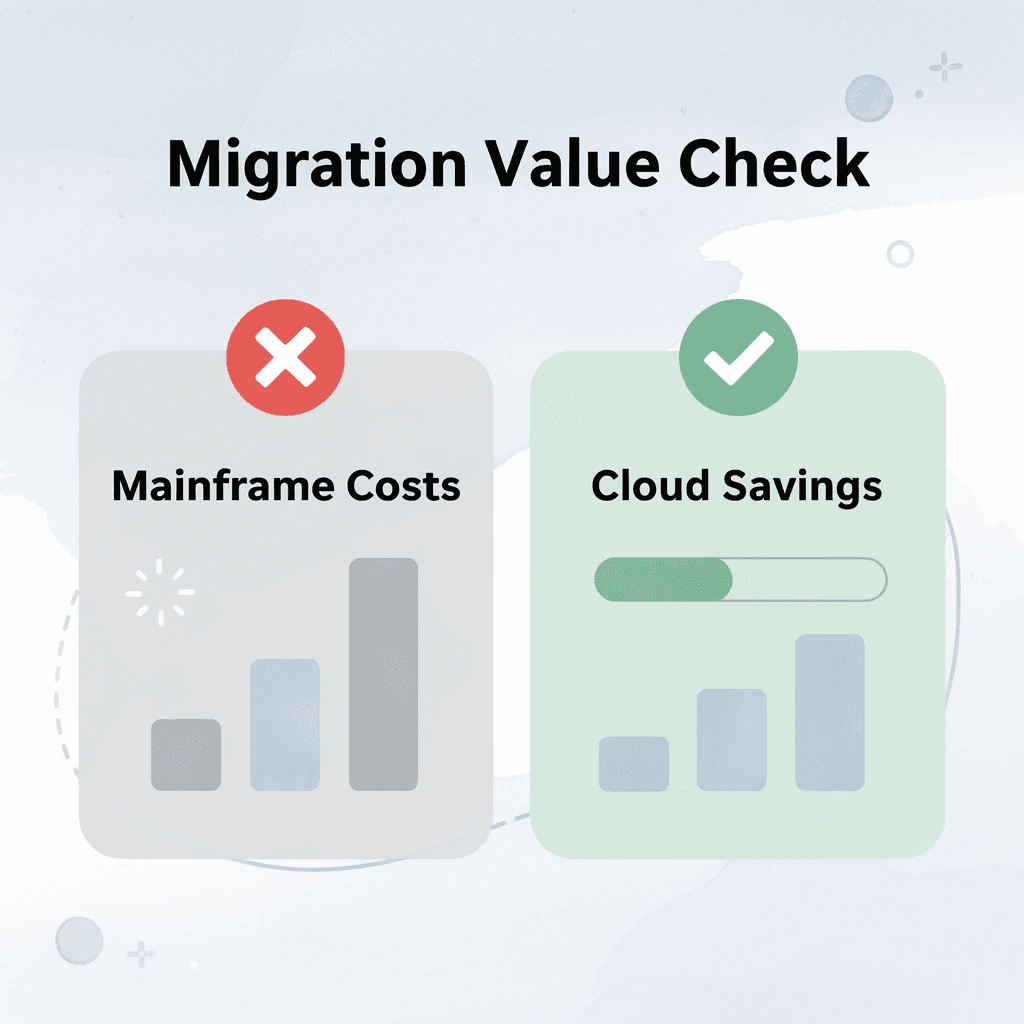
Track reductions in infrastructure, maintenance, licensing, and operational expenses against pre-migration baselines. Compare monthly cloud bills, staffing costs, and power usage to legacy mainframe expenditures, factoring in consumption-based charges. Successful migrations achieve savings through rightsizing, reserved instances, and elimination of hardware refresh cycles. Ongoing monitoring with cost-allocation and anomaly-detection tools prevents bill creep and sustains optimization.
Performance and Scalability Improvements
Check response times, throughput, batch processing duration, and scalability across varying user loads. Measure transaction speed, resource utilization, and the system's ability to auto-scale during peak demand. Cloud platforms enable dynamic resource allocation to handle growth without substantial upfront equipment investment. Regular testing and monitoring confirm these improvements deliver better user experiences and more reliable operations.
Uptime, Reliability, and Disaster Recovery Effectiveness
Track your system's uptime, mean time between failures, potential data loss, and recovery time. These metrics reveal system stability and resilience. Compare incident rates before and after your cloud migration against your legacy mainframe performance. Also, measure backup restoration speed. Leading cloud providers offer built-in redundancy, geographically distributed servers, and automatic failover. These features reduce downtime and accelerate recovery, protecting both your finances and reputation.
Security, Compliance, and Risk Management
Check how often security problems occur, compliance audit pass rates, vulnerability remediation times, and data protection effectiveness to ensure the migration strengthened controls rather than created vulnerabilities. Monitor access management performance, encryption coverage, and adherence to standards like GDPR and PCI DSS. Cloud environments offer advanced monitoring and automated compliance tools that typically outperform legacy systems when properly configured.
Business Agility and Innovation Metrics
Measure deployment frequency, feature velocity, developer productivity, and adoption of modern technologies like AI and analytics integrations. Track how quickly teams deliver changes and value compared to legacy mainframe systems. Successful migrations free up resources for innovation by reducing maintenance work and enabling cloud-native development practices.
User Experience and Adoption Rates
Check user satisfaction through surveys, usage frequency, error rates, and support ticket volume before and after the move. Monitor login success rates, session duration, and feedback on performance or interface changes. High adoption, paired with positive experiences, confirms that the migration enhanced daily operations for employees and customers.
Overall ROI and Strategic Value
Figure out ROI by comparing all migration costs against money saved, revenue impacts, productivity gains, avoided hardware expenses, and new opportunities enabled by the cloud. Include hard-to-measure benefits like risk reduction and market positioning. A complete ROI analysis demonstrates how the project supports business goals and guides future portfolio decisions.
How CodeGiant Simplifies Mainframe-to-Cloud Migration
CodeGiant closes the gap between legacy systems and cloud-native architectures by pulling out, changing, and putting existing logic into place—making fast migration possible without losing the governance that regulated industries need.
"The biggest challenge in mainframe migration isn't the move itself—it's preserving critical business logic and compliance controls throughout the transition." — Industry Insight
💡 Tip: When evaluating migration tools, prioritize platforms like CodeGiant that automatically preserve governance frameworks—this is especially critical for regulated industries such as finance, healthcare, and insurance.
🎯 Key Point: CodeGiant doesn't just lift-and-shift—it extracts, transforms, and redeploys existing logic, enabling fast, compliant migration without sacrificing the operational integrity your business depends on.
|
Migration Capability |
Traditional Approach |
CodeGiant Approach |
|---|---|---|
|
Logic Extraction |
Manual, error-prone |
Automated and precise |
|
Governance Preservation |
Often lost in transition |
Built-in throughout |
|
Migration Speed |
Slow, months-long cycles |
Accelerated delivery |
|
Cloud-Native Compatibility |
Requires heavy rework |
Seamlessly integrated |

Where undocumented logic stops being a blocker
The failure point in most migrations is not the cloud infrastructure—it's the business logic buried in COBOL programs that nobody fully documented because the people who wrote it retired years ago. CodeGiant's modernization pipeline performs automated dependency resolution and graph construction across legacy codebases, bringing hidden relationships to light before they become production incidents. A financial institution converting account processing modules avoids months of manual reverse-engineering. The pipeline maps data structures, verifies type compatibility, and produces traceable outputs that connect every converted line to its source, allowing audit teams to follow the chain of logic without guessing.
How does mainframe-to-cloud migration scale beyond manual review limits?
Most teams handle this through senior architect reviews and manual documentation sprints. As codebases grow past a few million lines, this approach breaks down: review queues lengthen, documentation falls out of sync with reality, and the window between discovery and cutover narrows dangerously. Our CodeGiant enterprise AI platform replaces manual review cycles with continuous automated analysis, converting COBOL to modern languages such as Java with Quarkus while preserving functional equivalence and generating the traceability artifacts that compliance teams need.
What changes when deployment is built into the pipeline
According to the Future Processing Mainframe to Cloud Migration Guide, moving from mainframe to cloud can cut infrastructure costs by up to 50%. The primary cost driver, however, is rework: the time spent validating converted code against production behavior post-deployment.
How does an embedded IDE compress the mainframe-to-cloud migration feedback loop?
CodeGiant's built-in IDE and one-click deployment accelerate this process. Teams improve converted services, run validation steps, and deploy to AWS, Azure, or Google Cloud without switching tools. Batch jobs that once ran on fixed mainframe schedules become responsive microservices that scale with demand rather than hardware limits.
What automation steps prevent data corruption during mainframe-to-cloud migration?
CodeGiant automates the mapping and validation steps that prevent corruption when mainframe file structures migrate to cloud databases. File chunking, path optimization, and real-time progress tracking provide teams visibility into each component's position in the conversion queue, eliminating reconciliation surprises that typically surface during post-migration audits.
Why the talent gap makes this more urgent than it looks
90% of Fortune 500 companies still rely on mainframes for critical workloads, meaning organizations with the highest operational risk depend on a shrinking pool of legacy expertise. CodeGiant's AI-assisted builders and prompt-to-production capabilities enable teams without deep COBOL expertise to contribute to modernization efforts. Developers focus on high-value refinements rather than manual conversions, distributing workload across teams otherwise locked out of the process. This shifts the economics of the entire program. The real question is whether your chosen platform can turn the modernization decision into something your teams can execute in production.
Try CodeGiant's Enterprise AI Platform Today
CodeGiant brings AI agents, enterprise integrations, workflow automation, and multi-cloud deployment into a single governed environment, so your teams stop managing the toolchain and start moving the work forward. For organizations in financial services, healthcare, government, or manufacturing, this shift from fragmented tools to unified execution is the point at which modernization programs stop stalling and start delivering.
"The shift from fragmented tools to unified execution is where modernization programs stop stalling and start delivering." — CodeGiant
💡 Tip: If your teams are spending more time managing tools than delivering outcomes, a single governed environment like CodeGiant is the structural fix — not another point solution.
|
Fragmented Toolchain |
CodeGiant Unified Platform |
|---|---|
|
Siloed AI agents & integrations |
Unified AI agents in one environment |
|
Manual workflow coordination |
Automated workflow execution |
|
Inconsistent governance |
Built-in governance across all tools |
|
Multi-cloud complexity |
Single governed multi-cloud deployment |
Visit CodeGiant to see how our enterprise AI platform supports secure deployment into your own cloud environment across AWS, Google Cloud, Azure, and Oracle Cloud, with deterministic execution and built-in observability included. The sooner your program moves from manual processes to governed automation, the sooner operational efficiency and scalability become measurable.
🎯 Key Point: Deterministic execution and built-in observability are foundational to running enterprise AI at scale with confidence, not optional add-ons.
✅ Best Practice: Organizations in regulated industries should prioritize platforms that offer secure deployment into their own cloud environment, ensuring data sovereignty and compliance are never compromised.
Related Reading
- Application Modernization Roadmap
-
Insurance Legacy Modernization
-
.net Modernization
-
Enterprise Architecture Modernization
-
Cobol Replacement
-
Iseries Modernization
-
Application Modernization Benefits
-
Rpg Modernization