Many organizations still run core business processes on COBOL systems built decades ago. The code works, but maintaining it grows more expensive each year, skilled developers are increasingly difficult to find, and technical debt accumulates steadily beneath the surface. Modernizing these legacy applications without disrupting operations or introducing unnecessary risk is one of the most pressing challenges enterprise teams face today. Choosing the right application modernization tools makes the difference between a smooth transition and a costly disruption.
A gradual approach tends to work better than a full rewrite or a high-stakes migration. Moving COBOL workloads to modern environments in stages reduces dependency on outdated infrastructure, lowers maintenance costs, and keeps business operations running without interruption. Teams that need real results without chaos benefit from purpose-built solutions designed for exactly this kind of transition, such as the enterprise AI platform.
Table of Contents
-
What Is COBOL Modernization, and Why Is It a Priority for Enterprise Teams?
-
What Challenges Do Organizations Face During COBOL Modernization?
-
Can AI Accelerate COBOL Modernization?
-
9 Steps for Successful COBOL Modernization
-
Best Practices for a Successful COBOL Modernization Initiative
-
How CodeGiant Simplifies Enterprise COBOL Modernization
-
Try CodeGiant's Enterprise AI Platform Today
Summary
-
COBOL systems remain deeply embedded in global commerce, not as relics but as active infrastructure. According to the Open Mainframe Project, an estimated 800 billion lines of COBOL code are in active use today, and roughly $3 trillion in daily commerce flows through these systems. Modernization in this context is not about fixing something broken. It is about evolving systems that still work but can no longer keep pace with modern development, cloud integration, or real-time data demands.
-
The talent gap is accelerating the urgency of modernization in ways that pure cost analysis tends to miss. The average COBOL programmer is around 55 years old, with approximately 10 percent of that workforce retiring each year, according to workforce analysis from MetaIntro. When those developers leave, they take decades of embedded business logic with them, logic that was never documented because the people who built these systems never expected to hand them off to someone else.
-
Full replacement carries far more risk than most project plans account for. The TSB Bank migration in the UK in 2018 resulted in customers being locked out of their accounts and a final bill of £330 million, driven largely by an underestimation of how tightly coupled the existing system was. This pattern repeats across industries, where migration speed outpaces parity testing and incomplete transitions collapse under real production load.
-
AI changes what is achievable within realistic timelines and budgets. McKinsey research shows generative AI delivers 40 to 50 percent acceleration in tech modernization timelines alongside up to 40 percent reduction in technology debt costs. Separately, one government organization achieved a 94 percent reduction in time to analyze legacy COBOL code, compressing an eight-hour task to roughly 30 minutes. These gains materialize only when AI operates within a structured, governed process rather than running independently.
-
Legacy modernization projects fail 70 percent of the time, according to DreamFactory's Legacy System Modernization Statistics, and the common thread across those failures is unpredictability. Outputs that cannot be audited, processes that cannot be repeated, and governance added after the fact rather than embedded from the start are what separate failed pilots from production-ready systems. The enterprises that succeed are the ones that redesign the modernization workflow around AI tools, not just adopt them.
-
Integration remains one of the most underestimated obstacles in any modernization effort. OpenLegacy research reports that 70 percent of global business transactions are still processed in COBOL, which means refactored components must connect to live, high-stakes data flows without interruption. Teams that build middleware workarounds to bridge old and new systems often recreate the same tightly coupled silos they were trying to escape, deferring the agility gains that justified the project in the first place.
-
CodeGiant's enterprise AI platform addresses this by collapsing discovery, logic extraction, dependency mapping, language conversion, and deployment into a single governed pipeline, so functional equivalence is validated before any output reaches a live environment.
What Is COBOL Modernization, and Why Is It a Priority for Enterprise Teams?
COBOL modernization transforms old COBOL-based systems into new setups that support modern development practices, cloud integration, and real-time data exchange — all while preserving decades of built-in business logic. For enterprise teams, it has shifted from a long-term roadmap item to an operational necessity, driven by growing costs, a shrinking talent pool, and the widening gap between what legacy infrastructure can deliver and what the business now demands.
"COBOL modernization is no longer optional — it is the bridge between decades of mission-critical business logic and the speed, scalability, and integration that modern enterprise demands."
💡 What This Means in Practice: COBOL modernization is not about discarding proven logic — it's about unlocking that logic so it can power cloud-native environments, real-time APIs, and modern DevOps pipelines without starting from scratch.
|
Modernization Driver |
What It Means for Enterprise Teams |
|---|---|
|
Growing Costs |
Maintaining legacy COBOL systems consumes disproportionate IT budgets |
|
Shrinking Talent Pool |
Fewer developers with COBOL expertise enter the workforce each year |
|
Cloud Integration Gaps |
Legacy infrastructure cannot natively support modern cloud environments |
|
Real-Time Data Demands |
Businesses now require instant data exchange that batch-based systems struggle to deliver |
⚠️ Warning: Treating COBOL modernization as a purely technical project is one of the most common and costly mistakes enterprise teams make — the business logic embedded in these systems represents irreplaceable institutional knowledge that must be carefully preserved throughout the transition.

Why do the stakes of COBOL modernization extend across entire economies?
The stakes are significant. According to the Open Mainframe Project, an estimated 800 billion lines of COBOL code remain in use today, with USD 3 trillion in daily commerce running through COBOL systems. These numbers describe the operational backbone of global finance, government services, healthcare administration, and supply chain logistics. Modernization is not about replacing something broken; it is about evolving something that still works but can no longer keep pace.
Why does the rip-and-replace assumption create more risk than it resolves?
The failure point is usually the assumption that modernization means starting over. Full rewrites of mission-critical COBOL applications carry enormous risk: logic errors introduced during translation, compliance gaps from incomplete migration, and operational disruptions that far outweigh the original maintenance burden. Teams pursuing wholesale replacement often manage two systems simultaneously for years, negating the intended benefit.
How does COBOL modernization avoid the two-extreme trap?
Most teams choose one of two extremes: freeze the legacy system and build workarounds around it, or commit to full migration and absorb the disruption. The workaround approach creates integration debt, in which modern cloud applications and APIs must speak a language that the core system barely understands. The full migration approach stalls at the proof-of-concept stage because the gap between a working demo and a production-grade system exceeds what most project plans allow. Our enterprise AI platform at CodeGiant enables teams to build production-ready applications, APIs, and automations on top of existing systems, moving incrementally without sacrificing the reliability or compliance controls the business depends on.
Why is the talent shortage accelerating the urgency of COBOL modernization?
The talent dimension accelerates the need for change beyond cost considerations. Experienced COBOL developers are retiring faster than organizations can document their knowledge. When critical institutional knowledge resides in a single person's understanding of a 40-year-old codebase, the organization faces a continuity risk, not merely a technology risk. AI-assisted code analysis tools now expose hidden logic, map connections between system components, and generate documentation at scales no manual process could achieve, fundamentally reshaping modernization decisions.
How do regulatory requirements shape the COBOL modernization business case?
Rules and regulations drive modernization forward. Older COBOL systems lack today's data privacy requirements, real-time audit trails, and the ability to update security rapidly. Modern systems built on containerized or cloud-native foundations offer automated compliance monitoring and faster update cycles without requiring major architectural changes for each new regulation. For financial services and healthcare, this flexibility is essential, not optional. The harder question is what gets in the way when organizations attempt modernization.
What Challenges Do Organizations Face During COBOL Modernization?
COBOL modernization fails mainly because of organizational, financial, and human obstacles rather than technical complexity alone. Understanding these structural forces is essential to avoid repeating costly mistakes.
"COBOL modernization is not purely a technical challenge — it is an organizational, financial, and human transformation that demands strategic leadership at every level." — Industry Insight
|
Challenge Category |
Key Obstacle |
Impact |
|---|---|---|
|
Organizational |
Resistance to change, siloed teams |
Slows decision-making and alignment |
|
Financial |
High upfront modernization costs |
Deters long-term investment |
|
Human |
Shrinking pool of COBOL expertise |
Creates critical knowledge gaps |
⚠️ Warning: Treating COBOL modernization as a purely technical project is one of the most common — and costly — mistakes organizations make. The human and organizational layers are equally critical to address.
🔑 Takeaway: Organizations that fail to account for structural forces — not just code migration — are far more likely to experience project overruns, failed rollouts, and wasted resources.
The cost problem nobody budgets for correctly
According to the Open Mainframe Project, over 800 billion lines of COBOL code remain in use today. Hidden business rules emerge late, dependency maps prove inaccurate, and rework accumulates. One European bank discovered this when undocumented logic buried inside mainframe modules forced years of additional fixes, pushing costs far beyond what leadership had approved. The failure was not technical incompetence but the assumption that scope was knowable before work began.
Where does institutional knowledge go when people leave
The average COBOL programmer is around 55 years old, with roughly 10 percent of that workforce retiring each year, according to workforce analysis from MetaIntro. When they leave, they take decades of business logic embedded in their code, which is never documented. Teams must then reverse-engineer the production code under pressure—a slow, mistake-prone, expensive process that can halt modernization programs for months.
Why does migration speed become the enemy of COBOL modernization?
The TSB Bank migration in the UK in 2018 demonstrates what happens when speed outpaces careful testing. Customers could not access their accounts, money went missing, and costs reached £330 million, as reported by The Guardian. The core issue was underestimating how closely the old system's components were interconnected. Similar failures occurred in U.S. state unemployment systems during the pandemic, when demand surged, and incomplete migrations collapsed under load, forcing agencies to revert to legacy systems. Such high-profile failures erode the trust modernization programs require to succeed.
How can teams avoid stalled COBOL modernization projects?
Most teams respond by slowing down, adding review layers, and extending timelines. But this often creates a different problem: modernization projects stall at the proof-of-concept stage, producing demos that never reach production. Platforms like CodeGiant address this gap by helping enterprises move from working prototypes to production-grade applications, APIs, and automations built on existing infrastructure rather than replacing it. The goal is controlled, predictable transformation, not another pilot that runs out of budget before it ships.
The integration trap that recreates old problems
OpenLegacy's research on COBOL modernization reports that 70 percent of global business transactions are still processed in COBOL. When teams connect refactored components to cloud services, microservices architectures, or modern APIs, incompatibilities often emerge late in the process, after significant investment. Teams then build middleware workarounds that recreate the tightly coupled silos they sought to escape, delaying the agility gains that justified the project. These obstacles aren't unsolvable, but clearing them requires tools and a mindset different from what most enterprises bring to the table initially.
Related Reading
- Build Internal Tools
-
Mainframe To Cloud Migration
-
Legacy Software Modernization
-
Cobol To Java
-
Build Internal Tools
-
Application Modernization Best Practices
-
Technical Debt Management
-
Ai Governance
-
Legacy System Modernization
Can AI Accelerate COBOL Modernization?
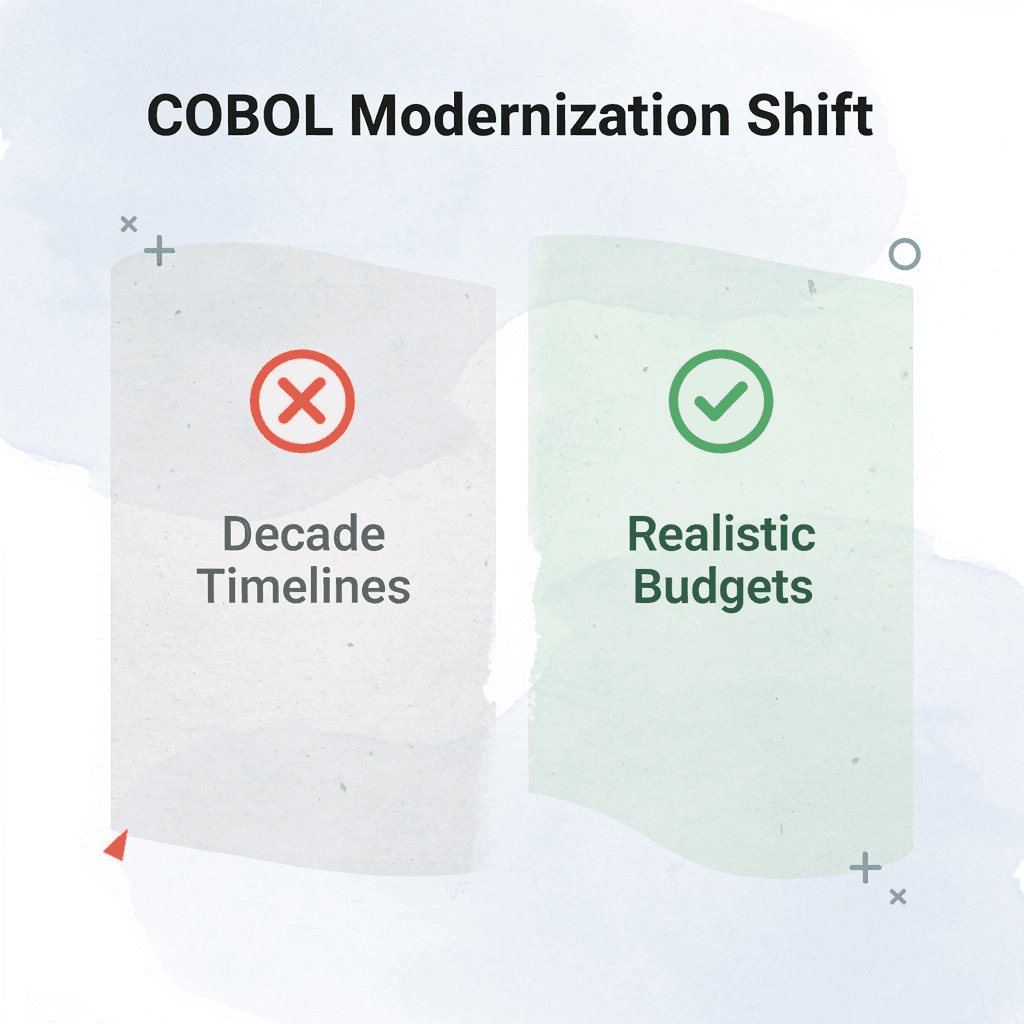
AI changes what's possible in COBOL modernization within realistic budgets and timelines. Obstacles that once required decade-long commitments—undocumented logic, dependency mapping, test coverage gaps—are now addressable with machine-speed tools.
"Obstacles that once required decade-long commitments — undocumented logic, dependency mapping, test coverage gaps — are now addressable with machine-speed tools." — Key Insight
🎯 Key Point: AI-powered modernization compresses multi-decade COBOL overhauls into achievable, budget-conscious timelines by automating discovery and mapping work.
💡 Tip: If your organization still treats COBOL modernization as an inevitable decades-long burden, reassess. Machine-speed tooling has fundamentally shifted the cost-effort equation.
What the scale of the problem actually demands
According to the Open Mainframe Project, 800 billion lines of COBOL code are in active use today, and $3 trillion in daily commerce flows through COBOL systems. No human team can reverse-engineer that volume with the speed and consistency production-grade modernization requires. AI models trained on COBOL syntax and patterns can scan millions of lines in hours, extract embedded business logic, identify hidden dependencies, and create documentation that would take months by hand. This represents a fundamentally different capability.
Why do manual processes quietly break down in COBOL modernization?
The failure point is usually not a single bad decision but the buildup of small gaps: undocumented workflows, calculations buried in legacy code, data type conversions that behave differently under edge conditions. Human reviewers miss these not out of carelessness but due to cognitive limits when working across codebases measured in millions of lines. AI-assisted dependency mapping and automated test generation close those gaps by providing experts with accurate information to evaluate.
How does automation free developers from becoming the bottleneck?
Most teams assign senior developers to manual code walkthroughs, which work for smaller projects. As codebases grow past tens of thousands of lines, walkthroughs become slow and difficult to manage. Relationship mapping that once took 30 to 40 hours can be compressed to roughly five hours when AI agents handle structural analysis, freeing developers to focus on validation and strategic decisions. Platforms like CodeGiant automate logic extraction, data mapping, and dependency resolution while keeping developers in control through an embedded IDE where they refine outputs rather than rebuild from scratch.
From proof of concept to production
A tool can generate a Java equivalent of a COBOL module in a demo environment, but production-grade quality in regulated industries requires deterministic validation rather than optimistic testing. The difference between a compelling proof of concept and a deployable system is governance: structured validation loops, type verification, and path optimization that confirm functional equivalence before deployment to live environments. Teams that treat AI as a code generator without that governance layer end up with outputs that look right but behave unpredictably under production load.
What does structured COBOL modernization look like at scale?
McKinsey research shows that generative AI delivers 40 to 50 percent acceleration in tech modernization timelines and up to a 40 percent reduction in technology debt costs, but those gains require a structured transformation pipeline. The National Organization for Social Insurance achieved a 94 percent reduction in time to analyze legacy COBOL code, shrinking an eight-hour analysis task to roughly 30 minutes. Both results share a common thread: the AI was embedded in a controlled process rather than running independently. Enterprises pulling ahead aren't simply adopting AI tools—they're redesigning the modernization workflow around them.
Related Reading
- As400 Modernization
- Enterprise Ai Governance
- Public Sector Digital Transformation
- Mendix Alternatives
- OutSystems Alternatives
- Appian Pricing
- Ai Agent Pricing
- Outsystems Vs Mendix
9 Steps for Successful COBOL Modernization
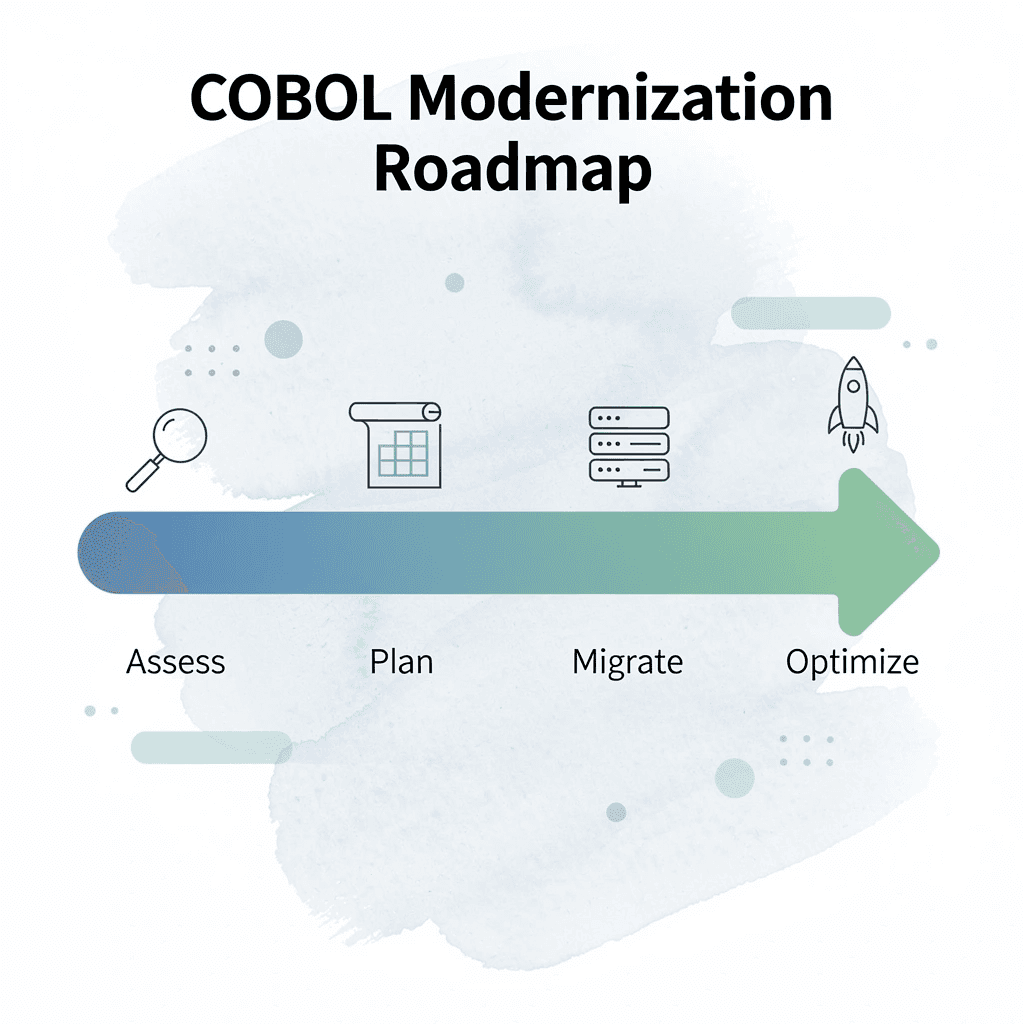
Successful COBOL modernization requires a structured roadmap that reduces risk, preserves mission-critical functionality, and prepares enterprise applications for cloud, AI, automation, and modern software development. The following steps reflect proven modernization practices recommended by leading enterprise technology providers and consulting firms.
"A structured modernization roadmap is the difference between a successful transformation and a costly failure — organizations that skip planning face significantly higher risk of project overruns, data loss, and system downtime." — Leading Enterprise Technology Consulting Firms
💡 Tip: Before diving into any modernization effort, ensure your team has clearly defined goals — whether that's cloud migration, AI integration, or workflow automation. A vague objective leads to costly missteps.
⚠️ Warning: Skipping a structured approach to COBOL modernization is one of the most common mistakes enterprises make. Without a proven step-by-step framework, organizations risk breaking mission-critical systems that power core business operations.
|
Modernization Goal |
Key Benefit |
|---|---|
|
Cloud Migration |
Scalability & reduced infrastructure costs |
|
AI & Automation Integration |
Faster processing & intelligent decision-making |
|
Modern Software Development |
Improved agility & developer productivity |
|
Risk Reduction |
Preserved functionality & business continuity |
🎯 Key Point: The 9 steps outlined below are drawn from proven practices endorsed by top enterprise technology providers — following them systematically is essential to protecting your organization's most critical assets while enabling future-ready transformation.
Step 1: Conduct Thorough Assessment and Inventory
Map every component of your COBOL environment: applications, databases, interfaces, and dependencies. Document business rules, data flows, and performance metrics. This reveals high-priority areas and hidden complexities, enabling a realistic timeline and resource planning.
Step 2: Define Clear Objectives and Success Metrics
Match your modernization goals with broader business priorities: cutting costs, accelerating delivery, ensuring compliance, or improving customer satisfaction. Set clear, measurable objectives such as reducing maintenance spending, deploying updates faster, or decreasing system outages to track progress.
Step 3: Choose the Right Modernization Strategy
Consider different ways to update your system: encapsulating to expose your API, moving to cloud infrastructure, refactoring to improve code quality, or rebuilding with modern languages. Choose the best approach based on your system's criticality, your team's skills, budget, and goals.
Step 4: Build a Cross-Functional Team and Governance Model
Bring together people from IT, business units, security, and compliance teams, plus outside experts as needed. Clarify roles, decision-making processes, and risk management procedures. This ensures accountability, prevents scope creep, and aligns technical work with business objectives.
Step 5: Develop a Detailed Roadmap and Phased Plan
Create a detailed project plan that breaks the initiative into manageable phases, including timelines, milestones, and contingency plans. Use pilot projects on non-critical modules to test assumptions and refine processes before scaling to core systems. This approach delivers early wins, builds internal confidence, and enables adjustments based on real results.
Step 6: Implement Modern DevOps Practices and Tooling
Add version control, automated testing, CI/CD pipelines, and monitoring tools to support iterative development. Containerize components where appropriate and establish continuous integration practices that work with both legacy and modern code. These capabilities reduce errors, accelerate releases, and create a foundation for ongoing maintenance.
Step 7: Execute Incremental Migration with Rigorous Testing
Move to the new system in phases by prioritizing the most important or risky parts first, whilst running both systems in parallel to verify results match. Conduct thorough testing of functionality, performance, and security at each step to ensure the new system operates identically to the old one. This approach minimizes business disruption and allows teams to learn from each phase before migrating larger system components.
Step 8: Focus on Data Migration and Integrity Assurance
Create a safe plan for moving your data that includes cleaning it up, matching it to the right places, and verifying accuracy. Use automated tools to handle large volumes of data while maintaining accuracy and compliance with privacy regulations. Careful data handling prevents damage or loss, which could undermine trust in your updated systems.
Step 9: Provide Training, Knowledge Transfer, and Continuous Optimization
Train internal teams on new technologies, processes, and tools, and document all changes. Establish ongoing monitoring, performance tuning, and feedback loops to improve the modernized environment post-deployment. This builds internal capability, ensures long-term sustainability, and positions the organization to adapt to future requirements.
Best Practices for a Successful COBOL Modernization Initiative
Making COBOL modern works best when you focus on how you do it more than on what tools you pick. Organizations that follow proven best practices lower their risk, finish projects faster, keep their important business logic safe, and set themselves up for long-term growth.
"Organizations that follow proven best practices lower their risk, finish projects faster, and keep their important business logic safe — setting themselves up for long-term growth." — COBOL Modernization Insight
💡 Tip: Before selecting a modernization tool or vendor, first establish your process framework — the how will always outlast the what in long-running transformation initiatives.
🔑 Takeaway: A successful COBOL modernization initiative isn't just a technology decision — it's a strategic commitment to process, people, and long-term scalability.
|
Focus Area |
Why It Matters |
|---|---|
|
Risk Reduction |
Protects critical systems from costly failures |
|
Project Speed |
Proven practices eliminate guesswork and delays |
|
Business Logic Preservation |
Safeguards decades of embedded institutional knowledge |
|
Long-Term Growth |
Ensures modernized systems scale with future demands |

Secure Strong Executive Sponsorship and Cross-Functional Alignment
Get clear support from senior leaders to secure needed resources and remove organizational barriers. Ensure IT work aligns with business goals through regular steering committee meetings with representatives from finance, operations, compliance, and technology. This prevents projects from stalling due to competing priorities or budget constraints.
Adopt an Incremental and Phased Approach
Break modernization into small, manageable pieces that deliver early value while minimizing disruption to live operations. Prioritize modules based on business impact, technical debt, or regulatory urgency, then expand successful patterns to additional areas. Phased execution allows teams to validate assumptions, refine processes, and demonstrate quick wins that build internal confidence and stakeholder buy-in.
Prioritize Comprehensive Assessment and Documentation
Spend time at the start creating detailed lists of all your systems, mapping how they connect, and documenting how your business works. Use automated discovery tools alongside expert reviews to uncover hidden connections between systems and assess their performance. This preparation reduces unexpected problems during migration and preserves critical knowledge that might otherwise be lost when team members retire.
Leverage AI-Powered Tools for Efficiency and Accuracy
Use advanced platforms that automatically analyze, improve, and validate code to accelerate progress while maintaining high standards. CodeGiant, for example, facilitates legacy code migration through structured steps that extract logic, map data, and automatically transform it to modern environments like Java Quarkus with one-click deployment across major cloud providers. These tools eliminate repetitive work and enable teams to move faster without sacrificing control or compliance.
Establish Robust Testing and Validation Frameworks
Use multi-layered testing strategies that include unit tests, integration checks, parallel runs with legacy systems, and regression suites. Verify that functions work identically, performance meets benchmarks, and security controls are in place at every phase to catch issues before production. Careful validation protects your business and ensures modernized applications work reliably in real-world conditions.
Invest in Skills Development and Knowledge Transfer
Create training programs that focus on specific needs, mentorship opportunities, and documentation standards to help internal teams own and improve modernized systems. Combine hands-on workshops with AI-assisted learning tools so teams understand modern technologies while retaining deep knowledge of original business rules. Strong internal capabilities reduce long-term vendor dependency and support sustainable innovation after project completion.
Maintain Focus on Security, Compliance, and Governance
Add security reviews, data privacy controls, and regulatory alignment to every stage of the initiative. Establish clear governance structures with defined escalation paths and audit trails to manage risks effectively. This approach prevents compliance violations and protects sensitive information throughout the transition to modern architectures.
Monitor Performance and Optimize Continuously
Set up monitoring tools to track key metrics across old and new systems during and after the migration. Use live dashboards to identify bottlenecks, adjust settings, and make ongoing improvements. Continuous optimization ensures you maintain value and adapt to changing business needs.
How CodeGiant Simplifies Enterprise COBOL Modernization
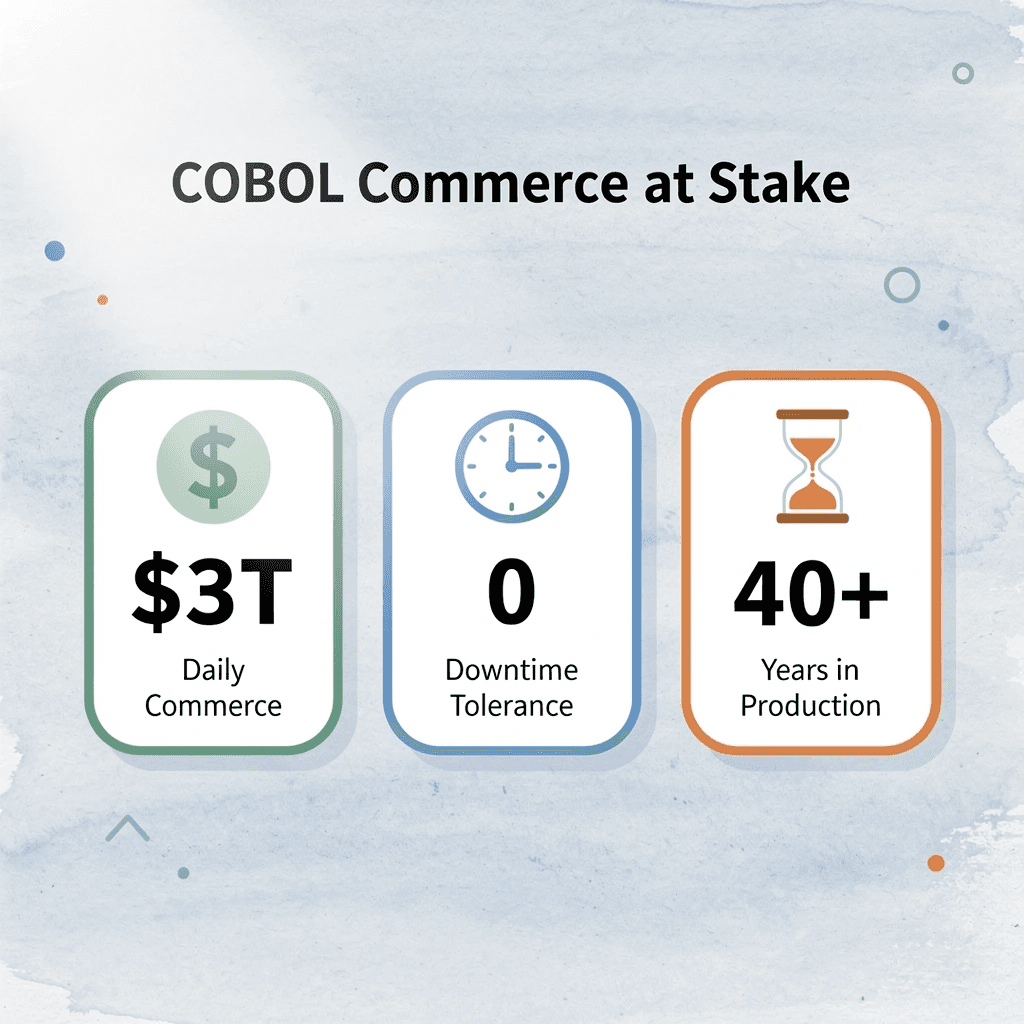
Redesigning modernization workflows around AI is necessary, but the real challenge emerges when systems process $3 trillion in daily commerce and cannot tolerate downtime, data loss, or compliance gaps, according to IBM Think. Most teams discover the answer through failure: a proof-of-concept that worked in a sandbox collapses under production constraints.
"Systems processing $3 trillion in daily commerce cannot tolerate downtime, data loss, or compliance gaps — yet most modernization proof-of-concepts collapse the moment they leave the sandbox." — IBM Think
🔑 Takeaway: When the stakes are $3 trillion per day, a modernization approach that works in theory but fails in production is not a minor setback. It's an enterprise-level risk.
The failure point is usually not the AI itself, but the gap between what AI generates and what enterprises can actually deploy. Undocumented dependencies surface mid-migration. Business rules buried in 40-year-old COBOL subroutines get lost in translation. Compliance teams flag outputs that are never validated against the original system's behavior. The modernization effort stalls because the process around it was never built for production.
|
Failure Point |
Root Cause |
Impact |
|---|---|---|
|
Undocumented dependencies |
Legacy code complexity |
Mid-migration collapse |
|
Lost business rules |
40-year-old COBOL subroutines |
Translation errors |
|
Unvalidated compliance outputs |
No behavioral benchmarking |
Regulatory flags |
|
Stalled modernization |
Process not built for production |
Project failure |
⚠️ Warning: The biggest trap in COBOL modernization is assuming that a successful sandbox test means production readiness — undocumented dependencies and buried business rules will surface only when it's most costly.
💡 Tip: Before any migration effort goes live, every output must be validated against the original system's behavior — compliance gaps discovered post-deployment are exponentially more expensive to fix.
Why do COBOL modernization projects stall before reaching production?
Most teams break work into separate phases: discovery, refactoring, testing, and deployment, each managed by different teams with handoff documents that quickly become outdated. As complexity grows, these handoffs become bottlenecks. Context gets lost between phases, validation gaps widen, and the distance between original and modernized behavior becomes harder to close with confidence.
Enterprise AI platforms like CodeGiant collapse those phases into a single governed pipeline. Rather than passing data between disconnected tools, our platform automates logic extraction, dependency mapping, type verification, language conversion, and deployment within a single continuous workflow. Teams see transformation progress file by file, with functional equivalence validated before deployment, ensuring output is production-grade.
How does a governed pipeline reduce COBOL modernization failure rates?
What matters at scale is deterministic automation and AI generation working together. According to DreamFactory's Legacy System Modernization Statistics, legacy modernization projects fail 70 percent of the time due to unpredictability: outputs that cannot be checked, processes that cannot be repeated, and governance added after the fact. A governed pipeline embeds compliance from the first file upload, not at the end when stakes are highest.
Enterprises that close the gap between experimentation and production are not those with the most AI tools, but those that have built processes where AI operates within defined limits, with human oversight at critical checkpoints and deterministic automation handling steps where consistency is non-negotiable.
Try CodeGiant's Enterprise AI Platform Today
CodeGiant closes the structural gap in COBOL modernization by connecting legacy systems through secure enterprise connectors, exposing existing business logic through governed APIs, and deploying production-ready applications into your own cloud infrastructure without risky full rewrites.
"The safest path to COBOL modernization is not a rip-and-replace—it's connecting, exposing, and deploying legacy logic through governed, production-ready infrastructure." — CodeGiant
💡 Tip: Secure enterprise connectors keep your legacy COBOL systems intact while powering modern applications, eliminating the single biggest risk in enterprise modernization.
Request a personalized CodeGiant demo to move your COBOL modernization from proof-of-concept into full production, with built-in observability, 24/7 AI SRE, and enterprise governance keeping your team in control.
|
Capability |
What It Delivers |
|---|---|
|
Built-in Observability |
Real-time visibility into every modernized workload |
|
24/7 AI SRE |
Round-the-clock reliability without manual intervention |
|
Enterprise Governance |
Your team stays in control at every stage |
🎯 Key Point: A CodeGiant demo takes your initiative from experimental to production-grade—with enterprise governance and AI-powered reliability built in from day one.
✅ Best Practice: Don't let COBOL modernization stall at the proof-of-concept stage. Production deployment with 24/7 AI SRE is within reach—request your personalized demo today.
Related Reading
- Application Modernization Roadmap
-
Insurance Legacy Modernization
-
.net Modernization
-
Enterprise Architecture Modernization
-
Cobol Replacement
-
Iseries Modernization
-
Application Modernization Benefits
-
Rpg Modernization